• 136 posts
  • 8 comments
Joined 6 months ago
Cake day: November 10th, 2025

cross-posted from: https://mander.xyz/post/52253809

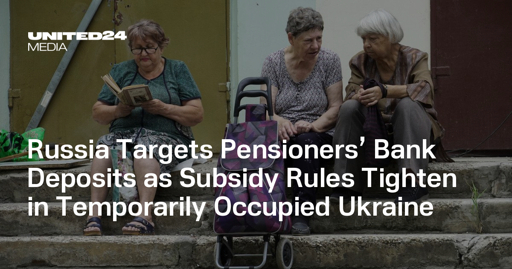
Russian occupation authorities will begin counting pensioners’ bank deposit interest when assessing eligibility for social benefits in occupied Ukrainian territories starting in June 2026.

The measure will factor in deposit interest when assessing pensioners’ “financial need,” affecting access to regional supplements, utility subsidies, and other social support.

Elderly residents are first pushed into Russian banking, pension, and registration systems, then those same systems are used to monitor income, restrict benefits, and impose new financial obligations.

Putin’s every move to preserve power accelerates decay, writes an anonymous former senior official in the Russian government in an op-ed for the Economist.

Vladimir Putin has led Russia into a dead-end and nobody has a map for what comes next. The first manifestation is a shift in the language used by senior officials, regional governors and businessmen: they have stopped using the first-person plural when talking about the actions of authorities in the country.

As recently as last spring, everything was “we” and “ours”. Mr Putin’s war on Ukraine may be reckless and failing, but it was shared. “We” were inside it, and it would be better for all of “us” if it ended sooner. Now they describe what is happening as “his” story, not “ours”. Not our project, not our agenda, not our war.

The authoritarian system can survive for a long time on fear, inertia and repression. It still has a monopoly on violence, but has lost its monopoly on shaping the future.

The irony is that Mr Putin started the war to preserve power and the system he has created. Now, for the first time since the conflict began, Russians are starting to imagine a future without him.

In the past three years assets worth around 5trn roubles ($60bn) have been seized from private businessmen and either nationalised or handed to loyalists and cronies, the largest redistribution of property since the mass privatisation of the 1990s. It is not that the elites have suddenly discovered a taste for the rule of law or democracy. But even those loyal to the regime crave rules and institutions that can resolve conflicts fairly.

At the same time, Russia is suffering an identity crisis. For the first time in generations it lacks an external model to define itself against. Historically it defined itself in relation to Europe and the wider West. They were there to catch up with, to fall behind, to confront. That old axis is gone. The West as a single cultural, military and political entity is in crisis. There is no “there” against which one can define “here”. This is not an ideological issue. It is structural.

All four factors create a situation which in chess is known as a Zugzwang: when every move worsens the position. The system can persist for as long as Mr Putin remains in power. But his every move to preserve and expand it accelerates decay. His instinctive response may be to intensify repression. He may start another war. But these actions would only make things worse. He cannot restore the connection between power and the future. He can only make the rupture bloodier and more dangerous.

Archive Today link

cross-posted from: https://mander.xyz/post/52049353

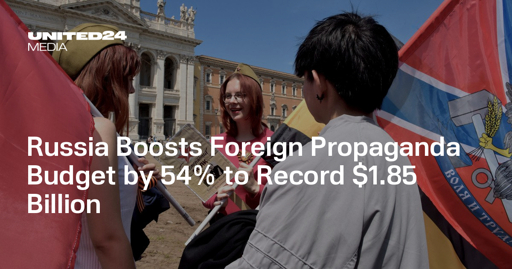
Russia allocated a record $1.85 billion for foreign propaganda operations in its 2026 federal budget, a 54% increase from the previous year, according to Ukraine’s Foreign Intelligence Service in a response to Liga.net on May 9.

Ukraine’s intelligence agency disclosed the figure in response to a Liga.net query, attributing the spending to Moscow’s information sector. The agency stated that the funds bankroll the systemic promotion of Russian narratives in European capitals such as Brussels, Vienna, and Luxembourg.

According to the intelligence service, the budget sustains Russian state offices abroad, finances networks of “Russian Houses,”

supports loyal foreign organizations, and launches new information platforms.

Investigators noted that after the European Union adopted its 20th sanctions package, which targeted pro-Russian media, Kremlin operators began rolling out mirror sites stripped of overtly pro-Russian sloganeering. The reworked outlets often feature interviews with European academics who claim they are being pushed out of their posts for calling for peace with Russia.

The “peace” messaging is meant to “create a suffering image” of Russia and frame Ukraine as the party blocking an end to the war, according to the intelligence service. Investigators also cited recycled Kremlin lines portraying Europe as weary of the war and arguing that Moscow cannot be isolated.

Russian microelectronics manufacturer Angstrem saw its profit from sales collapse nearly 50-fold in 2025 as mounting liabilities and restructuring costs deepened the financial troubles of one of Russia’s key defense-sector chipmakers.

The Zelenograd-based company reported profit from sales of 16.5 million rubles ($224,400) for 2025, down from 846.2 million rubles ($11.5 million) a year earlier, according to the company’s financial statements. Angstrem posted a net loss of 206.8 million rubles ($2.8 million) on revenue of 4.1 billion rubles ($55.8 million).

Russia’s domestic microelectronics industry faces ongoing difficulties as Western sanctions and years of failed investment projects weigh on companies deemed strategically important for the country’s military-industrial complex.

Web Archive link

Russia sharply downgraded its economic growth forecast for 2026, signaling the government is bracing for a prolonged slowdown as weaker oil revenues, high inflation and heavy wartime spending strain the economy.

Deputy Prime Minister Alexander Novak said the government now expects gross domestic product to grow by just 0.4% next year, down from a previous forecast of 1.3%.

The revised outlook, announced Tuesday, points to mounting concerns inside the government over the durability of Russia’s wartime economic model after more than four years of fighting in Ukraine.

The economy contracted by 0.3% in the first quarter, according to the Economic Development Ministry, even as President Vladimir Putin has urged officials and the Central Bank to accelerate growth.

Web Archive link

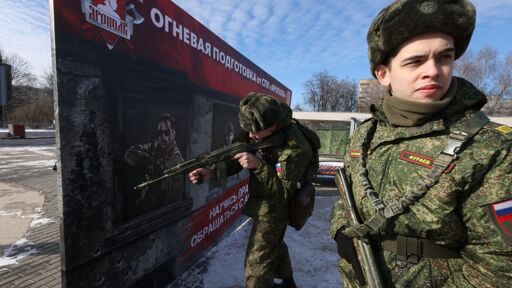
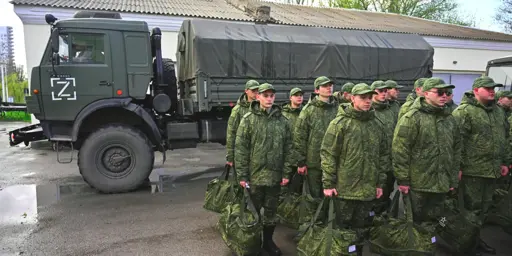
  • Russia spent more than 50 billion rubles over the past five years building and running military-patriotic centers where schoolchildren undergo mandatory military training
  • In these centers, teenagers from both Russia and Russian-occupied Ukrainian territories are being militarized
  • By September 2025, there were 147 centers nationwide. The regions are responsible for creating and funding them, with money allocated in part directly from regional budgets.

Describing the system as a “conveyor belt for preparing Russian teenagers for war,” an investigation by TVP World’s Russian-language sister channel Vot Tak reported that while the camps are officially voluntary, significant pressure is often applied to get children to attend.

One mother of a 10th-grade camp attendee told the outlet: “The teachers said you can’t refuse; you won’t pass the Life Safety test, and if you fail, you simply won’t be allowed into 11th grade.

“Those children who didn’t want to go were closely scrutinized and pressured,” the woman continued. “Parents were called in for a talk; the children were invited into a separate classroom and asked why they didn’t want to go and what their views were.”

The camps offer five-day courses during which cadets, typically aged 16 or 17, are taught weapons skills, battlefield first aid, and how to operate in conditions of biological, chemical or radioactive contamination, Vot Tak reported.

The camps’ official goal is to help young people acquire the skills needed for “rapid adaptation upon conscription,” but they are also used to promote military service and encourage young people to join the armed forces.

In addition to the Avangard centers, Russia is also rolling out a network of Voin (“Warrior”) centers, a parallel youth training initiative created on Putin’s orders shortly after Russia’s full‑scale invasion of Ukraine in 2022.

According to Vot Tak and official Russian materials, the Voin center network is already present in 21 regions of Russia, with plans approved by Putin to expand it to all federal regions. Vot Tak established that four of these “Warrior” centers are located in Russian‑occupied Ukrainian territory.

While there are no Avangard centers officially registered in Ukraine, Russia has actively pursued the militarization of Ukrainian youth in occupied areas through transfers to camps inside Russia and locally organized militaristic events, Vot Tak reported, citing a Ukrainian human rights lawyer.

Ksenia Kornienko, a lawyer with the Ukrainian organization Regional Center for Human Rights, told Vot Tak that Ukrainian youth are either sent to centers in Russia or enrolled in other types of military‑style programs in the occupied territories.

These activities have been documented in Crimea since almost immediately after Moscow annexed the peninsula in 2014, Kornienko said, adding that military training camps are organized at individual schools in the regional capital, Sevastopol.

Young people are trained at these camps by Russian veterans of the war in Ukraine as well as by members of the Russian National Guard and officers from the Black Sea Higher Naval School, Vot Tak wrote.

In the eastern Ukrainian regions of Donetsk and Luhansk, which Russian‑backed separatists declared as “people’s republics” in 2014, military training camps for schoolchildren have been integrated into the education system since the early years of the secession movement and intensified after 2022.

In the case of Ukrainian children, pressure is often overt, according to Kornienko, who considers these practices a human rights violation.

“We’ve documented cases where Russian military personnel have come to schools, forcing teachers to send some of their children to participate in these camps,” she said.

They’ve come to people’s homes and told them that if they don’t send their children to the camp, they’ll be stripped of their parental rights or [the children will be] sent to a boarding school. This is how they’ve encouraged parents to sign documents,” the lawyer told Vot Tak.

“This pressure indicates that a war crime has been committed—the deportation and forced displacement of children.”

Web Archive link

Here is an alternative report by Medusa, citing Vot Tak: Report: Russia has spent billions building military-patriotic centers to train schoolchildren

Maternity Hospital No. 2 in Vladikavkaz marked May 9 by dressing newborns in military caps and pinning St. George’s ribbons to them.

“The birth of a child is a symbol of the victory of life over death, of the end of war and the beginning of peaceful times!” one of the hospital’s doctors said.

A maternity hospital in the North Ossetian city of Ardon held a similar event. “Dear adults and little ones! Today is a very important holiday — Victory Day […] We congratulate you on this great day and wish you kindness, joy, and smiles,” the facility wrote on Instagram, alongside photos and videos of newborns in military caps adorned with red stars.

Web Archive link

Since its founding in 1830, Bauman University has been one of Russia’s most prestigious technical universities. “Courage, will, work, perseverance” are its stated principles. Today more than 30,000 young people study at the university in eastern Moscow. Its computer science faculty is considered its flagship; many graduates end up at the country’s most important tech companies.

However, Bauman University also secretly trains spies. According to 2,000 internal documents obtained by an international consortium of media outlets including Le Monde, Der Spiegel, The Insider, The Guardian, Delfi Estonia, VSquare and FRONTSTORY.PL, the university hosts a clandestine section never mentioned in its official organizational chart: “Department No. 4.”

Courses in Hacking and Propaganda

Each year, between 10 and 15 Bauman students are assigned—before even finishing their studies—to the GRU units they are expected to join after graduation.

Some are sent to the more infamous units of Russia’s military machine, such as Unit 74455, better known as “Sandworm” or “VoodooBear.” This group has been accused by US and European authorities of orchestrating destabilization operations during the 2016 US presidential election, as well as large-scale cyberattacks on Ukraine’s power grid in 2015 and on Poland in December 2025.

According to a Bauman University document, some of its agents work out of Anapa, a town on the Black Sea, at a previously unknown secret military base located next to the ERA military research center specializing in artificial intelligence. One of the leaked files listing dozens of students and their future assignments also reveals little-known GRU units such as 62174, based in Sevastopol in illegally occupied Crimea, and 48707, which shares an address with the GRU’s Scientific Research Center 11135 in Kursk, near the Ukrainian border.

Those who enroll in the course “Countering Technical Intelligence,” spend a total of 144 hours over two semesters learning the complete toolkit of modern hackers. This includes all digital intrusion tools for penetrating foreign computer systems: from simple password attacks and the exploitation of known IT vulnerabilities to more sophisticated “trojans.” There are also “practical penetration tests” — hacking exercises. Especially important: Module 6, “Computer viruses.” At the end of the course, students must hack a test server.

The curriculum also covers tools and techniques for so-called distributed denial-of-service (DDoS) attacks. Such an attack — in which countless devices organized in botnets automatically bombard online services — recently caused problems for Deutsche Bahn customers when their app was unavailable for an extended period. Russian hackers also repeatedly take down the websites of institutions like airports and hospitals. It is a strategy of a thousand pinpricks.

More surprisingly, some classes introduce “experimental psychology” or the development of propaganda campaigns. One syllabus describes the “creation of a video for social networks, using manipulation, to support or refute a ‘hot’ topic,” promising to teach “information warfare” while citing the Prussian military theorist Carl von Clausewitz.

Even at this level of education, in a renowned institution, trainee hackers are themselves flooded with disinformation: Ukraine is described as a country “seeking nuclear weapons,” the West as having tried to destroy Russia in the 1990s and 2000s, and Russians in the Donbas region as threatened by a “genocide” backed by European countries. “This state-sponsored conspiracism structures and legitimizes Vladimir Putin’s regime,” Limonier explains. “Even among the country’s elites, these lies must be repeated.”

This mix of technical skills and conspiracy theories was designed by Lieutenant Colonel Kirill Stupakov, the professor in charge of the entire program—himself also an intelligence officer within Russian military intelligence. According to his CV, which was found in the leaked documents, Stupakov headed GRU Unit 45807 for three years, until July 11, 2025. Within his teaching staff, he brought in several of the most senior hackers from Russian military intelligence.

Web Archive link

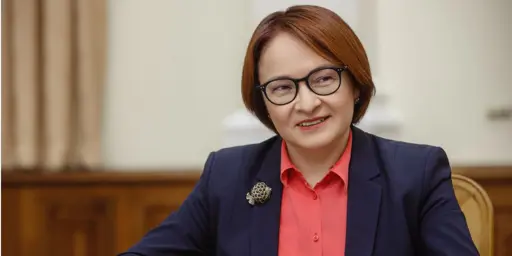
Household savings have become the main source of financing for Russia’s economy as sanctions shut Western capital markets to domestic companies, central bank chief Elvira Nabiullina said, as per The Moscow Times (original article in Russian).

“Before 2022, our borrowers and companies had access to, let’s say, the savings of citizens in Europe and the United States — actual savings. Because inflation in those countries was low and interest rates were low, our companies could borrow those funds at relatively low rates,” said Elvira Nabiullina.

“Put simply, our export sector, which borrowed abroad, could rely on financing from European and U.S. citizens to expand production of goods it exported there,” she said.

“But now global savings are unavailable to us,” Nabiullina added. “The only source of financing, practically the only one, is Russian savings — and high inflation, high interest rates.”

More than half of large Russian companies ended 2025 with declining profits, cut back or froze investment projects, and many are preparing layoffs.

For the first time, 74 Russian regions have fallen into fiscal deficit.

A wave of mass business closures has begun in Russia.

Russia’s Finance Ministry has acknowledged that the budget gap is widening at a record pace.

The state statistics service reported that more than 17,000 Russian enterprises declared losses.

VkusVill became the first major food retailer in Russia to scale back its network, closing 286 stores in 2025.

Magnit, the country’s largest retailer by store count, ended 2025 with a net loss.

On April 3, 2026, it was reported that 22 Russian industries had entered deep contraction.

Russian clothing retailer Zolla closed 35 stores amid a sharp drop in profits.

Meanwhile, Russia’s higher tax burden [to combat the rising public deficit due to war expenses) has sharply worsened conditions for small businesses, with around half of firms now operating without profit, according to business surveys, underscoring mounting pressure on an economy already strained by high borrowing costs and slowing consumer demand.

Half of small businesses surveyed by the Center for Strategic Research (CSR) said they were no longer profitable, while the Russian Chamber of Commerce and Industry (CCI) said 65% of enterprises failed to post a profit in the first quarter, the RBC news website reported.

“Many have slipped into losses because they were unable to choose the right tax regime,” CCI Vice President Elena Dybova [said].

Economic Development Minister Maxim Reshetnikov has previously said conditions in the Russian economy had become more difficult than in recent years, with businesses feeling the strain most acutely because of tax changes, high interest rates and labor shortages.

According to the CSR survey, the main factors holding back business development were weak demand, cited by 37.5% of respondents, rising costs (26.5%) and high borrowing rates (26%).

Around half of respondents (52.5%) said they had no access to credit financing.

Web Archive link

  • Regional deficits driven by lower profit tax revenues and higher social, war-related spending
  • Finance Minister urges minimizing costly commercial debt and working to cut deficits
  • Putin supports debt relief for regions
  • Putin aide says economic situation is complicated

The combined deficit of Russian regional budgets will grow by 27% to ‌1.9 trillion roubles ($25.4 billion) in 2026, largely due to lower corporate profit tax revenues and higher social spending, Finance Minister Anton Siluanov warned on Monday.

The regional budgets bear a significant share of spending linked to the war in Ukraine, such as payouts to war volunteers and their families, and regional debt is rising.

Profit tax revenues, which account for up to a third of total regional budget ⁠income, have been hit by Russia’s economic slowdown, which started in 2025. According to the latest available data for January, corporate profits fell by ​almost 30% year-on-year, as many companies report lower profits or losses.

“The situation with the regions’ budgets is challenging,” Siluanov told a hearing at the Federation Council ​upper house of parliament. He said the biggest deficits arose in regions that had traditionally been running budget surpluses.

Siluanov said that the regions’ debt as a share of revenues grew by one percentage point to 19% in 2025, as the regions were financing their deficits with bank loans at current high interest rates.

“Our task is to minimize commercial ​debt. Today, it is costly,” he said. The Russian economy slowed sharply to about 1% growth last year from 4.9% growth in 2024 and contracted in ​January in February this year due to high interest rates, tax hikes, a strong rouble and weak prices for Russian oil at the start of the year before the war ‌in the ⁠Middle East.

Russia’s oil and gas revenues are seen falling in the first five months of this year, Reuters calculations show.

  • Economy shrank by 1.8% in first two months
  • Putin has asked officials for growth policies
  • Communist leader warns economy risks stoking discontent
  • Comments look aimed at voters before parliamentary vote

The veteran leader of Russia’s Communist Party has warned parliament that the ​country’s faltering economy risks stoking a 1917-style revolution and that the government needs to take urgent measures to correct ‌its course.

Gennady Zyuganov, 81, issued his warning to a plenary session of the State Duma, the lower house of parliament, ahead of a parliamentary election due in September, according to a recording of his speech posted on the Duma’s official website.

Zyuganov ⁠said a recent government meeting convened by Putin had been the gloomiest in a long time.

“If you (the government) do not urgently adopt ​financial, economic and other measures, by autumn a repeat of what happened in 1917 awaits us. We don’t have the right to ​repeat that. Let’s take some decisions.”

Intercept released by Ukraine’s Intelligence suggests Russian commanders threaten and beat foreign recruits to force them into near-suicidal assaults.

An intercepted call released by Ukraine’s military intelligence (HUR) indicates Russian commanders may be coercing newly arrived foreign recruits into high-risk assault operations.

According to HUR, the recording captures conversations between Russian commanders discussing how to handle foreign fighters described as unwilling to carry out assigned missions.

In the call, one voice in Russian instructs a subordinate to prepare for the arrival of foreign personnel.

“Silva, you’re the one I need. Look, tomorrow they’ll bring in foreign specialists to you — they’re ready to carry out tasks, but they don’t really want to do it. Will you be able to force them to go?”

The response suggests that coercion is expected and normalized.

In a separate part of the conversation, the speaker appears to outline methods of enforcing compliance.

“You can beat the sh*t out of them, just not the legs — we need the legs. But yeah, you can. We’ll have to force them to go, otherwise we’ll have to go ourselves. And there’s no real desire for that, f**k, so we’ll still have to make them.”

Ukrainian intelligence says the exchange reflects a broader pattern of coercion within Russian ranks, extending to foreign nationals recruited to support operations in Ukraine. Physical violence and intimidation remain key tools used by commanders to compel participation in combat missions, particularly among those reluctant to fight.

Since the start of its full-scale invasion, Russia has sought to supplement its forces with foreign recruits, including individuals from Africa, Asia and the Middle East, often drawn by financial incentives.

HUR has warned foreign citizens against traveling to Russia for work or military service, urging those already deployed to seek surrender through official channels such as the “I Want to Live” initiative.

Web Archive link

A majority of Russian companies have effectively frozen hiring through the end of the year as weakening demand ripples through the economy, according to a report by the Central Bank.

The findings point to a broad shift in the labor market after several years of acute worker shortages, suggesting that slowing economic activity is beginning to ease pressure on employers — though without triggering widespread layoffs.

Some 64% of companies surveyed by the regulator said they do not plan to change staff numbers this year, citing subdued demand for their products.

The share was highest in transport and logistics, while firms in industry, mining and manufacturing were less likely to report a hiring freeze.

Web Archive link

The Russian social network VK removed the mutual aid section from a diabetes community called “Nyura Sharikova. Sakharny Diabet” at Roskomnadzor’s request, the project’s founder Nyura Sharikova announced on April 21. The independent Russian investigative outlet iStories drew attention to her statement.

The removed section, called “I’ll Give Away Insulin,” had allowed members of the VK group — which has 32,000 subscribers — to freely give away or exchange blood glucose test strips, glucometers, and insulin needles, and to find insulin or continuous glucose monitoring systems.

Data from the U.N. and the WHO as of early 2025 show that nearly 5.5 million people in Russia have diabetes — and specialists say up to half of all cases go undetected.

People with diabetes in Russia have complained of disruptions in drug supplies caused by procurement problems. In March, the Russian business daily Vedomosti reported that endocrinologists proposed that diabetes medications be dispensed primarily to working-age patients.

Web Archive link

Russian consumers are increasingly switching to cheaper food products as real incomes come under pressure and households look to cut costs, a senior executive at the country’s largest food retailer said.

Yekaterina Lobacheva, president of X5 Group, which operates the Perekrestok, Pyaterochka and Chizhik chains, said the company had observed a sharp rise in demand for low-cost items and store-brand products.

The trend underscores a cooling in consumer demand in Russia’s slowing economy, where high interest rates and persistent inflation concerns are weighing on household spending, even as officials say price growth is easing.

Web Archive link

cross-posted from: https://mander.xyz/post/50839757

Russia could attack a European country because it benefits China, Admiral Rob Bauer, former NATO Military Committee head and chief military advisor to the Alliance’s Secretary General until January 2025, said in an interview with NV on April 20.

“I believe in this [that Russia could attack a European country], but it is not related to Ukraine,” he said.

“It is related to China. So, the scenario that deeply worries NATO is that China is forging ties with Russia to attack Taiwan, because if Russia attacked a European country, if that happens, the U.S. would have to choose and fight on two fronts. One front is Europe, and the other is in the Asia-Pacific region. This is the scenario now being considered, and it causes concern for NATO. And since Russia is increasingly becoming a Chinese satellite, it will likely have to do it. I think this is a very alarming scenario.”

Russia strategically lost the war against Ukraine because the conflict turned Russia into a Chinese satellite, unable to continue the war without Beijing’s help, he added.

“It is unacceptable for China if Russia loses the war,” the former NATO secretary general’s advisor noted.

“However, China is simultaneously not interested in Russia winning the war. A long war benefits China because it keeps us, the democratic world, occupied as we support you.”

The European Union will hold exercises to test its mutual assistance mechanism in the event of armed aggression against one of its member states.

Russia could seize an island in the Baltic Sea to “test NATO’s resolve,” The Times cited Swedish Commander-in-Chief Michael Claesson in an article published on April 15.

Russia launched a disinformation campaign in Lithuania about the “Klaipėda People’s Republic,” the Center for Countering Disinformation reported on April 12, citing data from the Lithuanian State Security Department.

Moscow will take “appropriate measures” if EU countries provide their airspace for Ukrainian drone attacks on Russia, Kremlin spokesperson Dmitry Peskov stated on March 31.

If Russia attacks any European Union member state, it will be regarded as an attack on the entire bloc, European Commission spokesperson Thomas Regnier stated in response.

Web Archive link

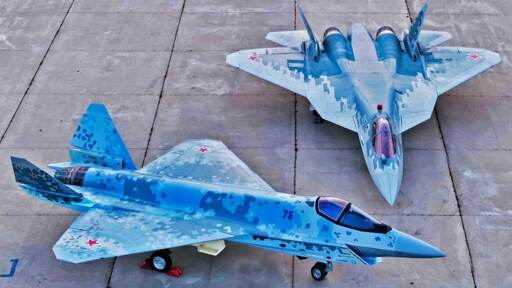
Russia would like you to believe that its Su-57 fighter is the world’s leading stealth fighter. Sporting two large, high-output engines, a canted V-tail, and contouring along the nose and airframe intended to confound and defeat enemy radar, it ticks many of the anticipated boxes. But Russia’s newest fighter might be in trouble.

There are doubts about the Su-57’s true stealth capabilities. Is it really a fifth-generation fighter?

There are questions about future production capacity, too: a Su-57 production facility recently appears to have caught fire, according to satellite images.

Web Archive link

Here are earlier versions of the deleted Samsung blog post (in Russian language) preserved in the Internet Archive and in Archive Today.

Samsung published a support page showing users how to isolate apps, using Russia’s state-backed messaging app Max as an example.

The post, titled “How to install apps or messengers in the Knox Folder on Samsung Galaxy?”, was flagged by the Telegram channel Yozh, though Samsung had published the tutorial in late March.

In the post, Samsung explained how moving apps into Knox can isolate data and “create a ‘second phone’ inside the device.”

“This guarantees maximum privacy for personal data and conversations, password/biometric protection, separation of work and personal life (you can use a second account), and additional data encryption,” Samsung said.

The tutorial included illustrations showing Max being “isolated” as an example. After journalists drew attention to the post, Samsung removed the images featuring the “national” messenger. The earlier version of the page was preserved in an internet archive.

Web Archive link

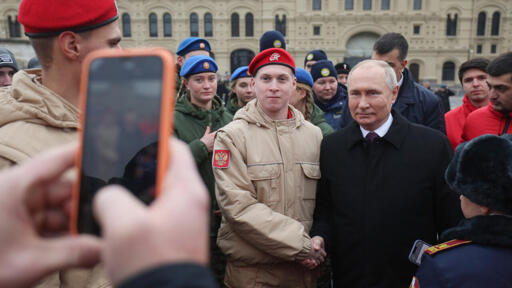
“We have created a huge team of kids, who understand how to broadcast government values and our organisation’s values,” Vladislav Golovin, a former soldier and chief of the general staff of Russia’s Young Army cadets movement, said in a statement released by the group.

In a promotional video from the event, children were shown cheering a cadet racing against Golovin to see who could reload a sniper rifle the fastest.

Another organisation, the Movement of the First, runs competitions offering rewards for teenagers with the best blogs and biggest followings. ‘Easy to radicalise’

The training camps are part of what Keir Giles, director of the UK-based Conflict Studies Research Centre, calls a “concentrated campaign to restore the prestige of the Russian military.”

“These 14–16-year-olds have grown up in an environment where they have never known anything other than Putinism. This is their reality, and so we should not be surprised if these new efforts to spread information reflect that reality,” he told AFP.

Social media content can be “direct and radical” or “very subtle, aimed not at generating support for Russia, but at decreasing solidarity with Ukraine,” said Dietmar Pichler, a disinformation and propaganda analyst at INVED.

At the training camp in Moscow, the Young Army cadets were quick to grasp the power of their new skills.

“When you are the one behind the camera filming the entire process, making audiences happy, you realise … you are the one who has aroused these emotions in people,” a girl said in a promotional clip published by the organisers.