• 12 posts
  • 3 comments
Joined 2 years ago
Cake day: June 26th, 2024

Archived version

“Instead of taking responsibility for peace and security in the world as a permanent member of the UN Security Council, China is opposing our core European interests with its economic and weapons aid to Russia,” German foreign minister Annalena Baerbock said in an emailed statement before departing Berlin airport on Sunday for her two-day visit to Beijing.

Vladimir “Putin’s brutal war of aggression against Ukraine is a direct threat to our peace. I will also speak in Beijing about the fact that we cannot simply ignore this in our relations with China.”

The European Union is proposing to sanction several Chinese firms that it claims helped Russian companies develop attack drones that were deployed against Ukraine. Baerbock will meet her Chinese counterpart Wang Yi in Beijing to address this issue, her spokesman said. Germany’s top diplomat will also discuss the humanitarian situation in China, as well as EU tariffs against Chinese electric vehicles that were introduced in October.

UK-based company Space Solar is partnering with Reykjavik Energy and Icelandic sustainability initiative Transition Labs to develop a space-based solar power plant that can deliver about 30 megawatts of electricity – potentially enough to power between 1,500 and 3,000 homes – from 2030. The system will collect sunlight in space through solar panels and then transmit it as radio waves at a specific frequency to a ground station, where it will be converted to electricity for the grid.

The satellite is expected to be scalable and quite big. Even if a full version of their CASSIOPeiA power array is not built, we are talking about the heaviest single object in space that is not a space station, and when all the arrays are splayed out, much larger than the International Space Station.

The company aims to have a scaled-up version of the system in space by 2036, which would supply gigawatts of electricity.

cross-posted from: https://feddit.org/post/4157628

cross-posted from: https://feddit.org/post/4157529

James Robinson, along with Daron Acemoglu and Simon Johnson, has been awarded this year’s Nobel Prize in Economics for his research on the critical role institutions play in fostering national prosperity. In [this Q&A session]l with EL PAÍS, he explains that his work also seeks to highlight how the legacy of colonialism has impeded economic development in certain regions, particularly in Latin America and Africa.

James Robinson: […] we make a simple division, focusing on the presence of inclusive institutions or extractive institutions. Inclusive institutions create broad incentives and opportunities for all people equally, while extractive institutions concentrate benefits and incentives in the hands of a few. Many economists say that development comes from entrepreneurship and innovation, but in reality it comes from people’s dreams, creativity and aspirations. To be prosperous, you have to create a series of institutions that can cultivate this talent. However, if you look at countries like Colombia or Nigeria, talent is wasted because people do not have opportunities.

[…]

Institutions can be an obstacle to competitiveness. However, one should consider the impact that European integration had on countries such as Spain, Portugal or the former Soviet countries. These are remarkable success stories. There has been an almost unprecedented transition. It is true that there may be too much regulation or inefficient rules, but broadly speaking the effects of European institutions has been largely positive over the past 50 years.

[…]

[Immigration] is one of the big questions we have to solve. […] it can be difficult. It is not easy to quickly incorporate the millions of people who cross the Mediterranean [trying to reach Europe]. One of the possible ways is to help them develop in order to improve the terrible situation in their own countries. However, one of the biggest complications is that the policies recommended by Western institutions are not in tune with what is happening in these [developing] countries. At the World Bank, for example, you cannot talk about politics. How do we expect them to solve real problems when you cannot talk about them? Frankly, it doesn’t make sense. If we really want to change the world, we have to have honest conversations. I see that as a long way off.

[…]

The reality is that democratic countries have shown that they are better at managing public services and achieving rapid growth. You can find impressive examples like China among autocratic countries, but you cannot achieve an inclusive economy with an authoritarian regime and a model like the Chinese one.

[…]

I don’t think the Chinese model can continue. If you look at other authoritarian regimes, like Iran or Russia, they are incredibly weak economically and technologically. The economy cannot flourish in an authoritarian regime. Right now, technological dynamism is concentrated in one such country and in the Western world. However, one has to consider that, with Donald Trump, the institutions that have made the United States great are being seriously questioned. This could affect the context, and that is why the European Union and NATO are so important.

[…]

[Populism is linked to the growing disconnect between governments and citizens] and an example of this is Latin America. Democracy promised too much and did not always deliver. People’s lives did not change, and they sought new alternatives. There are various factors why democracy has not achieved transformations, such as clientelism and corruption. […] Venezuela was governed in a deeply corrupt manner, and Hugo Chávez was clever in taking advantage of it. You also see this with Donald Trump, who has gone far because he realized there was widespread dissatisfaction with traditional politics. The failures of democratic institutions are real, and that is why we have to think about how to make them more empathetic to what people need.

[…]

Artificial intelligence can be wonderful, but like all technologies, it depends on how it is used. If artificial intelligence is used to create replacements for humans, that could be devastating. […] It is all about how it is used, and that depends on our governments. I think that these decisions should not be left to the tech gurus. They only think about what makes them the most money, even if this is not related to the general well-being of society. In the case of artificial intelligence, it is very important, because it could have a tectonic impact on the world.

Archived link

The far-right government of Italian Prime Minister Giorgia Meloni has proposed a new security decree that would criminalize non-violent protests that block roads and resisting a police offer in prison or in a migrant reception center. The opposition has dubbed the legislation “anti-Gandhi” for targeting the forms of peaceful resistance advocated by the Indian civil rights leader.

The law approved by Congress on September 18, and just needs to be passed by the Senate, where the government wants it to be on the top of the agenda. The security decree creates up to 20 new criminal offenses or aggravating circumstances and increases prison time for offenders.

[…]

Participating in road or railway blockades can lead to a month in prison, but if it is done in a collective mobilization, a person could face between six months and two years. What’s more, the security decree introduces an aggravating factor, which increases the penalties by up to a third. In view of the recent protests against the Messina Strait bridge and high-speed trains, a defendant will receive a longer prison time if their actions were aimed at preventing “a public work or a strategic infrastructure from being completed.”

[…]

The League [the right-wing political party that forms part of Italian Prime Minister Georgia Meloni’s government] also proposed for chemical castration for rapists and pedophiles. Matteo Salvini’s populist party has managed to get at a technical commission approved to study the possibility of chemical castration for convicted sex offenders, provided they voluntarily accept the procedure. Under the plan, they could receive suspended sentences in exchange for hormone-blocking treatment. It is a measure that is applied in Russia, Poland and some Scandinavian countries, but there is debate about its effectiveness.

[…]

Meloni’s security decree has been met with unusually strong opposition from the country’s judiciary. Fabrizio Vanorio, a public prosecutor from Naples, warned: “It provides for technically fascist rules. If approved, it would return Italy to an authoritarian criminal law similar to that of the Mussolini years or, to give a more modern example, yo that of Orbán’s Hungary.”

Archived link

The Independent International Commission of Inquiry on Ukraine found new evidence showing common patterns of torture by Russian authorities against Ukrainian civilians and prisoners of war in occupied Ukrainian territories and in the Russian Federation.

The wide geographic spread of locations and the prevalence of shared patterns in the way torture is committed demonstrate that torture has been used as a common and acceptable practice with a sense of impunity, the Commission said in its latest update to the Human Rights Council today.

The Commission’s further investigation into cases of torture provides evidence that Russian authorities committed torture in the Ukrainian regions where they have taken control of territories. The new evidence reinforces the Commission’s previous finding that torture committed by Russian authorities has been widespread.

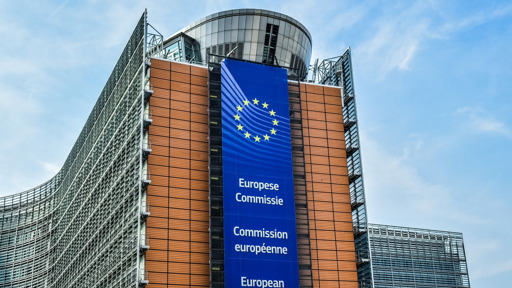
A few weeks ago the European Commission made the decision to stop funding the Next Generation Internet initiative (NGI) in its then current draft for the Horizon Europe 2025 Work Programme. This decision results in a loss of €27 million for software freedom.

Now you can ask for these funds and criticise the Commission’s decision, by taking part in the ongoing consultation on the Digital Europe Programme.

By participating in this consultation, which closes on 20 September (midnight Brussels time) you can help to advocate for a digital future that puts users in control of technology. Your input makes a difference.

The consultation on the linked website is available in all EU languages. It also provides hints how to take action.

Addition: You may also be interested in signing the petition about ‘public code’, claiming that code paid by the people should be available to the people.

cross-posted from: https://feddit.org/post/2778064

Moscow has funnelled billions of dollars to its army, soldiers, their families and weapons makers to sustain its military campaign – a spending splurge that helped it defy Western hopes that sanctions would push it into economic collapse.

But after warning for months that the economy was overheating, the country’s Central Bank has lately started mentioning the possibility of another, possibly more challenging development: stagflation.

“The shortage of (labour) resources may lead to a situation where economic growth slows down, despite all the efforts to stimulate demand, with all that stimulus accelerating inflation,” Central Bank Governor Elvira Nabiullina said over the summer.

“In essence, this is a stagflation scenario, which can only be stopped at the cost of a deep recession,” she warned.

‘De-modernising’

Stagflation – a period of low or stagnant growth accompanied by high inflation – would present a fresh headache for the Kremlin, which has until now navigated the economic fallout of its offensive on Ukraine better than most believed possible.

Moscow has increased government spending by almost 50 percent since sending troops into Ukraine, pushing up growth and wages.

Unemployment is at a record low and consumer confidence is its highest in 15 years.

But an exodus of both skilled and unskilled workers – who fled mobilisation or joined the army – has created millions of unfilled vacancies. Sanctions on Western technology have also hit productivity and damaged supply chains.

“In the long-term these demographic factors and technological issues will result in very low economic growth,” Ruben Enikolopov, a Russian professor at the Barcelona School of Economics, says.

“There is a high probability of a stagflation scenario in 2025 and the years after. It’s not a certainty, but high likelihood,” he added.

Based on public statements by defense-sector officials and his own interviews, military expert Maxim Starchak, a Fellow at the Center for International and Defense Policy at Queen’s University, concludes that the growing shortages of workers in the military-industrial complex are an insoluble problem.

Speaking in July at the second so-called Personnel National Congress of the Defense-Industrial Complex, Alexei Nechaev, a Duma deputy and rector of the Promsvyazbank Academy, called the shortage of workers in the defense sector “a significant problem.” Defense enterprises currently need about 160,000 specialists, he said. Promsvyazbank, a once-private bank that was nationalized after it failed, is the main financial institution supporting defense procurement, while its corporate academy provides specialized training for employees of the bank and the defense sector.

[…]

Over the past one and a half years, they [Russian defense enterprises] have managed to bring in 520,000 new workers, but shortages persist. Whereas at the end of 2023 the Ministry of Industry and Trade reported that about 75,000 specialists were needed in the defense sector, six months later that figure more than doubled (growing 115%). Meanwhile, according to First Deputy Prime Minister Denis Manturov, whose portfolio includes industry, the needs of the defense sector for 2025 are even greater – namely 250,000 workers.

[…]

In Russia, the military-industrial complex comprises 6,000 enterprises employing about 4 million people. Yet many more people work for the defense sector in one way or another, with about 10,000 more enterprises being auxiliary companies and contractors.

[…]

First Deputy Duma Chair Denis Kravchenko said that the labor deficit in the defense sector should be “urgently dealt with.” Andrei Peregudov, who heads the military-industrial complex department at the Ministry of Industry and Trade, noted that though the industry has managed to mobilize resources, “much remains to be done, especially since the defense sector competes for personnel with civilian sectors of the economy.”

[…]

The “demographic hole” in Russia (by late 2022 the number of workers under 30 years old had dramatically decreased) only intensifies the competition for personnel. “There are now half as many young people on the labor market than required,” says Natalia Nikulinskaya, head of HR at Penza PTPA, a manufacturer of pipeline fittings.

Obviously, the war in Ukraine has significantly exacerbated the demographic issues. According to career consultant Galina Babkova, based on official data and calculations by independent media, 650,000 able-bodied men went to war in Ukraine.

[…]

Even though workers without skills and experience are immediately offered a good salary, it is still hard to find people, says Larisa Smirnova, an HR expert from Kostroma.

[…]

At the end of 2022, the Sverdlovsk Region branch of the Federal Penitentiary Service announced that it would send 250 inmates to do forced labor at Uralvagonzavod.

This practice continued in 2023, but the numbers are too small to make a difference. The problem is only growing – for example, in Novosibirsk Region in 2024, the personnel shortage in the defense sector increased 30% versus last year, amounting to 2,000 people.

[…]

On top of this are problems with the quality of education. “The current education system requires modernization, as many educational institutions teach purely fundamental basics, using textbooks from the last century. In educational institutions, equipment for training is often unavailable, and if it is, it is commonly machines from the last century, which are very far from modern equipment,” says Rossko’s Kuzubov.

In addition, educational institutions often do not have instructors with knowledge of the latest practical skills, says Svetlana Dyukova, director of educational projects for Russian Welding Team. Vocational colleges hire retired instructors and cannot train students in modern technologies.

[…]

The labor shortage is dragging on defense procurement, President Putin acknowledged last year. Experts agree that the shortage will continue, and the issue insoluble. The consultancy Yakov and Partners predicts that by 2030 the deficit will reach 2-4 million people.

In June, industrial output in Russia slowed sharply, with the subsegments of military equipment and optics/electronics production falling for two straight months. This suggests that industry is plateauing amid the labor problems and tight monetary policy. Salary increases and other measures have ceased to push workers into industry, which is starting to slip.


Archived link

European Commission spokesperson Peter Stano said on Aug. 7 that “Ukraine has the legal right to defend itself, including striking an aggressor on its territory,” in comments to Suspilne in reference to the ongoing battles in Russia’s Kursk Oblast.

“The EU continues to fully support Ukraine’s legitimate right to defense against Russian aggression and its efforts to restore sovereignty and territorial integrity,” Stano said.

Ukrainian forces crossed the border into Kursk Oblast on Aug. 6, resulting in clashes on Russian soil that were described by Russian President Vladimir Putin as “a large-scale provocation.” Kyiv has not commented on the fighting in the area.

[…]

In response to the ongoing situation, U.S. National Security Council spokesperson John Kirby said that Washington hasn’t changed its policy of allowing Ukraine to use American-supplied weapons “to target imminent threats just across the border.”

When Russia launched its intensified offensive against Kharkiv Oblast in May, a number of countries said they had lifted restrictions on the use of Western-provided weapons against military targets inside Russia.

  • That’s a too simplified abstract of what the article is about. It’s not that Russia made the racist far-right in Western Europe and elsewhere (the Putin regime appears to provide some funding to European right-wing parties, though, as we have seen in Germany’s AfD, for example), it’s that Putin fuels that sentiment. The Russian government tries to actively destabilize the societies, that alone is a violent act and by many considered an act of war.

    (And, no, Britain is not “racist AF”, some people over there are racist. We should not pidgeonhole a country, neither Britain nor Russia.)

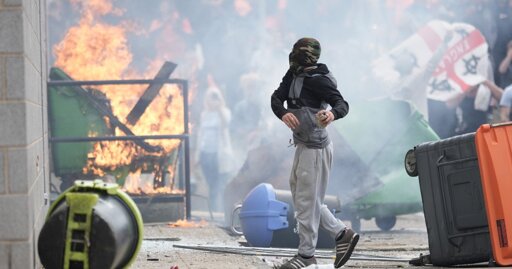
After a young man killed three young girls aged between 6 and 9 and injured many more in the town of Soutport in England.

Soon later, information on Twitter, now known as X, surfaced online claiming that the perpetrator was a 17-year-old Muslim refugee. This was not true, as the murderer, Axel Rudakubana, was born in Britain and had lived in the country all his life in a family of Rwandan origin.

Nevertheless, the fake news had an impact. A tweet claiming the murderer was a Muslim amassed 27 million views, igniting unrest across the nation.

The source of this misinformation was the site Channel3 Now, which poses as an American news agency but is not. Channel3 Now mostly collects and publishes fake news and has roots tracing back to Russia. The site’s YouTube channel, launched 12 years ago, originally featured videos in Russian from the city of Izhevsk. In 2019, this changed to English-language content about the Middle East.

Channel3 Now picked up a tweet by Bernie Spofforth, known for spreading conspiracy theories. Although Spofforth deleted his tweet almost immediately, Channel3 Now managed to share it and did not remove it. Channel3 Now became the source from which the misinformation spread through social networks and into other media. Leaders of the English Defence League also propagated it.

The resulting riots are still ongoing in various cities across the UK. Despite the fake news being debunked long ago, the riots continue. Local police are urging people not to participate, as civilians, local businesses, public places, and police officers are suffering, with several officers already injured.

In essence, Russian fake news have sparked large-scale riots across the UK, demonstrating the power of this type of weapon.

Slovakia and Hungary have increased pressure on Kyiv after they said last week they had stopped receiving oil from Lukoil via Ukraine. Hungary receives 2 million metric tons of oil from the Russian group annually, around a third of its total oil imports, Hungary’s foreign minister Peter Szijjarto said.

The two countries have initiated a consultation with the European Commission, he said, adding the Commission had three days to respond.

If the consultation procedure did not yield results, Hungary and Slovakia would take the issue to an international court of their choosing instead, he said.

The Ukrainian foreign ministry did not immediately respond to a request for comment, though the head of Ukrainian energy firm Naftogaz acknowledged a lack of oil from Lukoil.

Archived link

Those who incite to genocide typically attempt to dehumanize their victims, but it is disturbing that Andrei Perla’s ‘justification’ for Russia’s killing and maiming of sick children has elicited so little reaction.

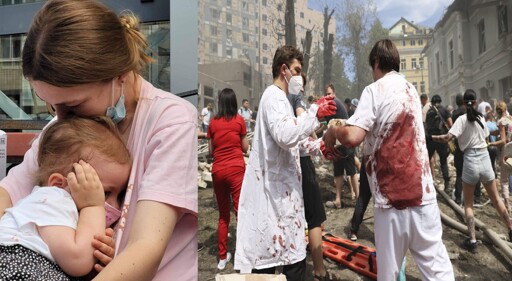
Russia’s missile attack on Okhmatdyr, Ukraine’s main children’s hospital, aroused enough international outrage for Moscow to go into denial mode. Not so, however, Russian propagandists, one of whom positively told Russians to quit making excuses. The strike was no accident, according to Andrei Perla, a columnist for Tsargrad, and can be repeated as Ukrainian children, any Ukrainians “cannot be considered people”.[…]

In the propagandist’s own words:

“The pitiless law of war is very simple – such enemies cannot be considered people. We must acknowledge the simple and terrible [truth] that there are no people on the other side. Not one person. Our missiles do not kill people, not one person. There are no people there.”

“Simple and terrible, but we shouldn’t try to justify ourselves for hitting a children’s hospital. We need to say: do you want it to stop? Then surrender. Capitulate. And then, perhaps, we will spare you.

“If we don’t forbid ourselves from viewing them as people, from pitying them, protecting them – we will weaken ourselves. We will restrict our ability to save our own children. We will obstruct the path to Victory.”

“If the aim of the SMO* is to ensure Russia’s security, denazify and demilitarize Ukraine, then the path to this aim is for surviving Nazis [sic] and all their families to have to flee in panic to the West. Before the Polish border. From shelling. From the ruins of their cities and homes, losing on the way their blue and yellow flags and slippers.”