
I thought the same thing about the steam deck and it turned out to be entirely fine.
This is basically cutting the screen out of a steamdeck so I’m pretty excited for a good controller.
- 0 posts
- 17 comments
Joined 3 years ago
Cake day: June 11th, 2023
You are not logged in. If you use a Fediverse account that is able to follow users, you can follow this user.
I thought the same thing, but per it’s suggestion I tried using it for fine tuning on the steam deck and I was pleasantly surprised. I’d never use it for for large motions, but on a game designed with mouse motion in mind it can be a little tricky to get those fine motions locked in.
I tried with portal and it made it a lot easier to get little adjustments lined up that were tricky without it. Since it exclusively kicked in when I wanted it to it wasn’t as wacky as a lot of gyro controls are for games that focus on them, and I think it was as simple as “press your thumb a bit more roundly onto the joystick”.It’s not going to supplant the mouse for fast precise motions, but it at least means you can skip the wild overcorrection that sometimes happens with joystick on unoptimized configurations.
- ricecake@sh.itjust.worksto
 1 year
Yes. The most charitable interpretation is that people have forgotten the lessons of the 1900s and think that a replay of Herbert Hoover is a good idea.
Last time it took a few decades and destroying countless lives to fix. Hopefully the cost is lower this time.

- ricecake@sh.itjust.worksto
Yes, I understand what you’re saying, it’s not a complicated position.
Your position is that national reputation matters more than anything else. And most pointedly, the national reputation of your allies matters more than any other argument.What I’m saying is, is that the actions the US, or any other nation, took before the people currently running things were even born have no bearing on current events. Nations aren’t people, and they don’t possess a national character that you can use to try to predict their behavior or judge them.
Would the world be justified in concluding that it’s only a matter of time before Germany does some more genocide? Before Japan unleashes atrocities across Asia?
If you’re getting down to it, the US can’t control other nations, beyond stick and carrot means. And the US has the same right to try to keep Iran from getting nukes as Iran does in trying to get them. Because again, nations aren’t people. They don’t have rights, they have capabilities.
And all of that’s irrelevant! Because the question is, is Israel justified in attacking Iran? The perception of hypocrisy in US foreign policy isn’t relevant to that question.
- ricecake@sh.itjust.worksto
No, what I don’t understand is what relevance that has to this situation. The US using nukes on Japan 80 years ago doesn’t make Iran making nukes justified. It doesn’t validate Iran not having nukes. It neither strengthens nor weakens Israeli claims of an Iranian weapons program, and it doesn’t make a preemptive strike to purportedly disable them just or unjust.
It seems like you’re arguing that the US nuked Japan and therefore Iran, a signatory to the nuclear nonproliferation treaty, is allowed to have nukes. Israel is falsely characterizing their civilian energy program, and we know this because of their backing by the US.
It’s just a non-sequitor, particularly when there’s relevant reasons why US involvement complicated matters. .
- ricecake@sh.itjust.worksto
What does that even mean? How is what a nation did generations ago relevant to two different nations in a totally different scenario?
- ricecake@sh.itjust.worksto
The USs actions in world war two are an odd thing to bring up in this context. It was a radically different set of circumstances, 80 years ago, and none of the people involved are alive anymore.
It’s entirely irrelevant.May as well point out that the US was the driver for the creation of those watchdog groups and is a leading force in nuclear disarmament. It’s just as relevant to if Iran has a nuclear weapons program or Israels justification for attacking.
Iranian opposition to US strategic interests in the region giving the US a strong motivation to let anything that makes them weaker happen is a perfectly good thing to mention.
- ricecake@sh.itjust.worksto
The things that are cheaper to make in the US were already made in the US.
Because of the high cost of labor here, we tend to specialize in things where the unit cost is so high that the labor cost doesn’t matter as much and spending extra for educated and skilled workers becomes a cheaper upgrade. Things like jet engine parts, engines, and machine tools.
Also things where you make a lot of them in an automated fashion, like precision screws and nuts or refined petroleum products. We’re probably not making the plastic bags or chairs, but we would be making the giant tub of plastic beads used for the injection moulding, which is then shipped to Malaysia to be moulded, and then back to the US to be a deck chair.The set of industries that are close enough to the line to make sense to move to the US and can be moved quickly enough for it to matter is vanishingly small.
It’s why most of our exports have been intangible for so long.
- ricecake@sh.itjust.worksto
I believe it’s paid as part of clearing customs. Since everything is in some capacity inspected (even if that just means checking the weight, container seals, and serial numbers in the freight container), that means there’s some record of what’s coming in and from where. At that point the importer pays customs the various fees and taxes before customs let’s them take the goods out of the port of entry.
The importer would mark it down as part of the taxes that they paid on their purchase, but it would largely only matter so that they can appropriately indicate what portion of the purchase price was taxes that have already been paid so they don’t double pay later.
- ricecake@sh.itjust.worksto
Right now there are three “biggest powers” on the world stage. US, China and Russia. China has belligerent rhetoric towards a lot of their neighbors, particularly Taiwan. They want the areas they control, but largely stop short of action. It’s why they claim the South China sea, and other nations need to pointedly ignore their claims to delegitimize them.
Russia has been openly annexing, or trying to anyway, their neighbors, and using historical precedent as their excuse.
As the largest power, the US very notably not annexing land nearby shifts the tone way into the realm of it being the norm not to do that.Annexing, or at least threatening to, nearby land makes it more that all major powers do so, or at least are looking for opportunities to do so.
If cold war schemes give the US historical claim to Greenland, then Russias claims on Ukraine start being less unhinged and more generally expansionist.

- ricecake@sh.itjust.worksto
Should have said you’d be delighted for them to visit, and then just not let them inside. Deny any knowledge of talking to them before. Waste their time and money and call them names.
- ricecake@sh.itjust.worksto
I don’t think they’re that clever. Seriously. I think that all the “distractions” are crazy things their major supporters want (less regulation on putting raw sewage in drinking water), crazy things their policy architects want for stupid or awful reasons (ending birthright citizenship because you think America should be a white Christian nation), naked adoration for dictators because they’re what running a country like a business looks like, or just the most transparent “negotiation” that burns good will because you don’t understand that getting an agreement is good, and getting an agreement where the other side is happy too is better.
Threaten tariffs and wait a while to let the other side offer something to get you to not do it. Threaten to annex Greenland, and then compromise on guaranteed transit rights in their territorial waters and maybe some resource extraction agreements. Same for the Panama canal.
- ricecake@sh.itjust.worksto
The military that he just dismissed the leadership of and replaced with his own people, and the CIA that’s directed by his people?
- ricecake@sh.itjust.worksto
On what? It’s all crazy. “We’re going to invade Gaza” is just as insane as “we’re going to put 18 year olds in charge of the Treasury”, “eliminate the department of education” or “win the war on diversity”.
- ricecake@sh.itjust.worksto
They look like they’re in about the same position or lower than the sticks in the steam deck.
I’m guessing it’s a little lower since there’s no screen in the middle so your hands are angled together a little more.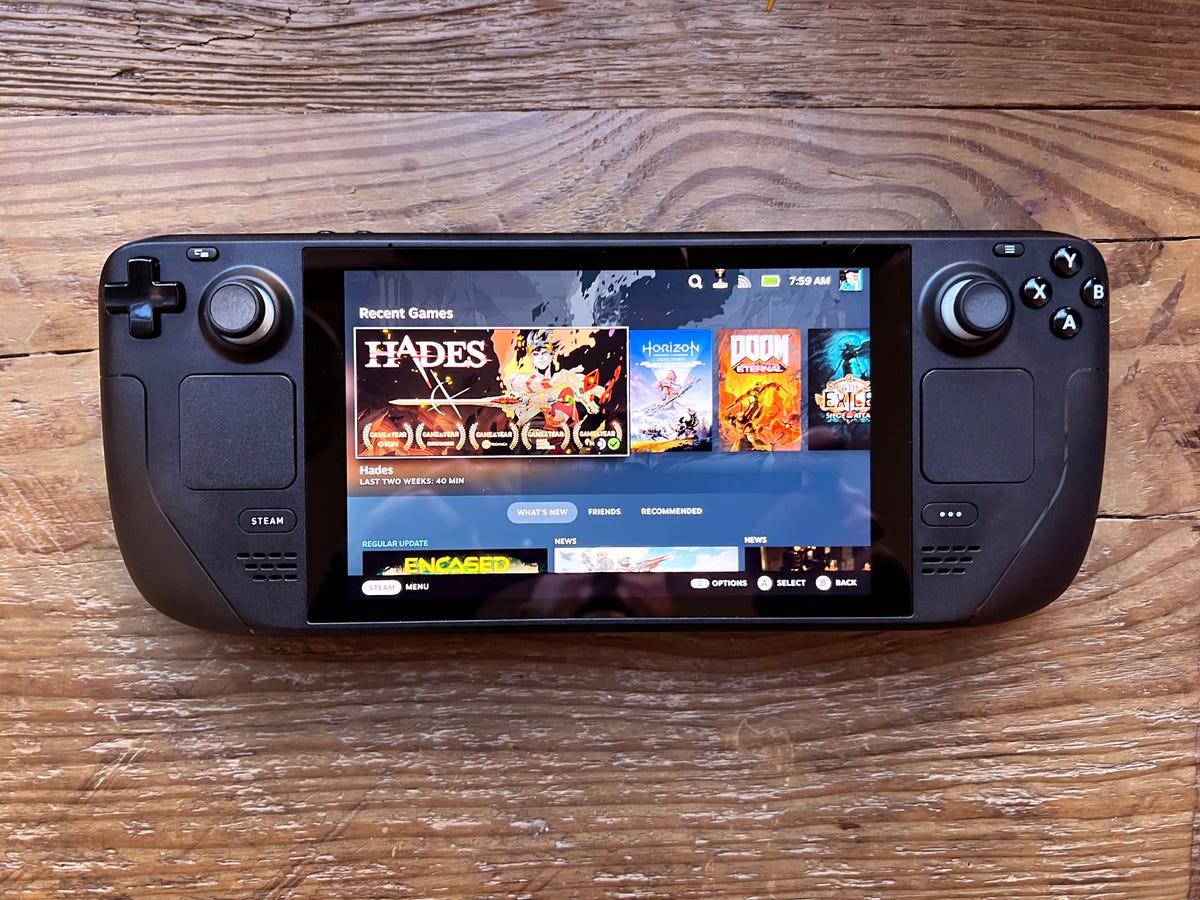
- 2 years
The notion of getting a special edition white one, then swapping the shell to a custom black is funny.
How the did it with the steam deck was nice. It wasn’t a pre-order in the usual sense, since you didn’t pay anywhere close to full price. Just a refundable $5 that would go towards the cost of purchase when you bought it.
I don’t mind that for hardware, since it cuts out scalpers and doesn’t obligate you to purchase something before you know the quality.